Showing posts with label 5x. Show all posts

Monday, September 28, 2015

The MaddAddam Trilogy: Oryx and Crake; The Year of the Flood; MaddAddam by Margaret Atwood


Format: Paperback (Boxed set)

Pages: 376; 448; 416

Source: Own (Gift)

Genres: Fiction, Speculative Fiction, Science-Fiction

Publisher: Vintage Canada

Publication date: July 28th, 2009; July 27th, 2010; August 12th, 2014.

Read on: February 22nd-28th; June 27th to July 5th; August 24th to September 1st, 2015.

Thoughts: One thing I should probably get out of the way is that I absolutely love Margaret Atwood. To this day I have not read something by her and not enjoy it. Her work on speculative fiction and science fiction is amazing, in my own opinion. So when my mother-in-law gave me the box set for the MaddAddam trilogy I was unbelievably happy, and I had to force myself to pace my reading (I did have other books to read before) of the whole thing. It was worth the effort since it not only gave me more time to digest all my thoughts, it made the experience last longer.

In the first book we are introduced to Jimmy-The-Snowman, possibly the last human on Earth. Through flashbacks we learn of the past world (still a futuristic world compared to where we are now), his best friend Crake and his lost love Oryx. The second book, told mostly from the view of Toby and Ren, sheds light on the other side of story, outside the compounds and into the plebes. The stories, both past and present, finally merge in MaddAddam, where all the final pieces of the puzzle come to place revealing all details of what happened to Earth and why it came to be what it is now. I am really trying to avoid spoilers here, but trust me, it’s a great story.

All three books are going to tackle subjects such as genetic manipulation, pharma and aesthetic procedures and finally, what pop culture/entertainment has devolved into, having (almost) every whim attended for via the Internet. As has been the case on any other book I’ve read from Atwood, characters are deeply flawed, making them even more human and involving. Unbelievable world building, and once again incredible speculative talent, particularly where it comes to science advances make this trilogy one of my favorites. I would recommend it to all my friends that are in science. If you don’t want any spoilers, this is probably the moment to stop reading.

Here is the thing. As a scientist this trilogy was both incredibly fun to read and nerve-wracking at the same time. Some of the scientific developments she describes, such as the Pigoons or the lab cultured meats, have already happened, albeit to a much smaller scale and so far with very different applications than the ones described in the book. Because I work in the academic/scientific world I am aware of where the research is (to a certain extent) and most of its limitations, even if I don’t work on that direct line of research.

But I have to wonder, what happens when someone’s first “contact” with genetic splicing or modified organisms comes through science fiction. How many of those readers will go and look for the actual science that this speculative fiction is based on? My distress comes from thinking that not many of them do and things like this only serve to fuel an uninformed fear towards what science can/can’t do when modifying genes, developing new drugs, etc.

I’ve already discussed why I think it’s so important for Science Fiction to have good science basis, and this trilogy is a great example of how amazing a piece of fiction can be with the proper scientific research to back it up. But because so many works of science fiction present these bleak and cold outcomes due to misuse of science, I can’t help but wonder how many of the people outside science are afraid of it precisely because of this dystopic panoramas. We could argue that only one “crazy” scientist is the culprit of pushing the tragedy to its final outcome. The point remains that a lot of the things discussed in this trilogy, while plausible, are presented in a scary way, which off course is understandable since we are talking about a dystopian view. I hope you understand the apprehensiveness I get about this being the first view of gene splicing some people will get.

As I’ve been writing this, I’ve been trying to think of an example where accurate science has been presented with a brighter view in fiction, and to tell you the truth, I haven’t been able to pinpoint one. This can be due to personal bias, as I do read a fair amount of dystopian fiction, but maybe you can help me out here. I believe that both sides of the coin (the bleak and the bright side of science) should be present in fiction, both for readers with scientific background and without out. I am fairly sure they are out there, I just haven’t found a book with a more cheerful outcome yet. If you have any recommendations, please, leave me a comment!

Tuesday, June 30, 2015

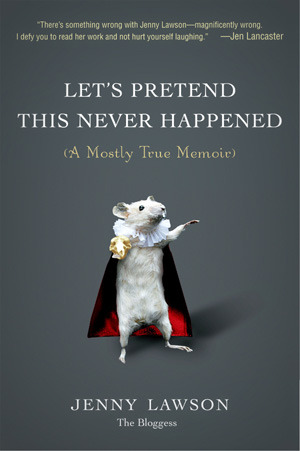
Let's Pretend This Never Happened: A Mostly True Memoir by Jenny Lawson


Format: Hardcover

Pages: 318

Source: Own (Book Outlet)

Genres: NonFiction, Memoir, Humor

Publisher: Amy Einhorn: Putnam

Publication date
: April 17th, 2012

Thoughts: First a confession, I bought this book based solely on my memory of everyone singing praises to it, but I had completely forgotten what it was about, let alone that it was a nonfiction book. But even then, I was not disappointed one single bit.

This book was just amazing. Maybe because I didn't know what to expect I was entertained all the way. I was laughing out loud in the metro...which got me very awkward looks from other commuters, but you know what? I didn't care, not one bit. It has been so long since a book makes me loose myself so deep in it that I don't really care about giggling and shaking my head in the bus, while others look at me as if I had issues.

The book, as the title mentions is a memoir of Jenny Lawson, also known as The Bloggess and here is the main thing about her: she is hilarious in that way that you just say stuff and they are inherent funny. Her voice (her book voice, JIC) is extremely vivid; half of the book I felt like she was right there and that just makes it even funnier, when you can feel the sarcasm, wit, etc. in her writing. That's my type of humor. 

On bloggers. #letspretendthisneverhappened #amreading

A photo posted by CaroGomez (@carolikesbooks) on


From her childhood dealing with quite disturbing puppets, to finding the love of her life, becoming a mom, getting friends and starting her own taxidermy collection, Lawson manages to bring humor to all of this, even when having panic attacks or darker stuff. There are heavy subjects here and I will agree with the author that if you are easily offended you should probably stay away from this book. Otherwise, go ahead and enjoy it. She is so earnest about how she feels and sees things going around her, and she has probably nailed the best definition to everyone who has blogged even for a little while. Definitely one of the best books I've read this year. 

Monday, May 18, 2015

A Little Life by Hanya Yanagihara

23165077Format: ebook

Pages: 669

Series: NA

Source: Library (OverDrive)

Genres: General Fiction, Literary Fiction

Publisher: Doubleday

Publication date: March 10th, 2015

Thoughts
: It took me a long time to sit down and write the review for this one. You see, it has been a long time since a book made me cry so much and so earnestly.

The book tells the story of 4 college friends: JB, Jude, Malcolm and Willem. We see them as time passes by, from their college dorm, through their careers and all that growing up might entail. They are not picture perfect characters, all with as much baggage as you can imagine (some more than others). All in need of love and friendship which, eventually is clear, can be the same thing.

First let's talk about the parts that weren't sad. The way the author presents their friendship, so full of flaws and hence so perfectly beautiful. The way Yanagihara shows the city of New York is also a thing of praise. You would think this city has been used so much that it cannot be shown with different eyes, and yet, the streets and the environments presented in A Little Life felt absolutely different for me. The mental picture of the city going in along with the feeling of whichever character we were listening too...and yes, I will say listening since their voices were so strongly jumping out of the pages into my head.

We could argue about whether there are four main characters or just two (some can even say that it's the story of Jude mostly) but for me their lives are so intertwined that I feel I could not answer to this argument. Their friendship, with so many ups and downs for the four of them, is at the end what carries all the emotions for me. It's the feelings between them: when they are happy, when they fight, when they love...as I'm writing, flashes of the story keep coming back and my heart contracts once again. I cannot say how Yanagihara did this, but I can tell you that I know this book will be with me for a long time.

You might be scared of such a big book. I know I was. When I saw that it was almost 700 pages, and knowing ahead that there were a lot of heart crushing moments (it was impossible not to gather that from people talking about the book around me) I hesitated a bit, afraid the book would've been too much. But the truth is that Yanagihara's language is so absorbing I didn't notice the time passing by. It is not through big words that she does this, just very poignant, on point phrases that catch you and won't let you go.

It's not a happy book. Far from it. There are extremely happy moments in the story, that's for sure; moments that made me so happy that I chocked a bit with them. But the thing is that through the story you go so high and so low that sometimes I had to put the book down and force me to do something else, for it felt like too much to take.

Some people have pointed out that all these ups and downs, the intensity of every feeling depicted in the book is exaggerated, and I agree. They are heightened for sure. But in the world of the story they didn't felt out of place and I realize as I am writing this that it might not make sense for a lot of people, but it did for me. And that's why I gave it a full 5, because as a whole everything fitted for me which is also why it got me so hard.

At the same time I don't know who I would recommend this book to, just because knowing how I felt all through the reading, I feel awful telling someone to put themselves in the same position, even if I feel that it was worth it at the end. 
 

Thursday, February 26, 2015

Yes, Please by Amy Poehler

Format: Audiobook

Pages: NA

Series: NA

Source: Own (Audible)

Genres: Non fiction, Memoir

Publisher: Harper Audio

Publication date: October 28, 2014

First impression

I've like Amy Poehler for a while now; I first saw her on SNL and enjoyed most of her characters, but mostly her and Tina Fey on Weekend Update. I read Bossypants and enjoyed it, so when I first heard about Poehler getting her own book out I knew I was going to read it. That said, I am very happy I went for the audio, since it is read, not only by her, but she has several guest narrators, that made the experience even more delightful. The book is funny without being solely that, it has very honest moments and a lot of heartfelt messages, about her career but also her personal life.
If you are lucky, there is a moment in your life when you have some say as to what your currency is going to be.
Final thoughts

I liked this book better than Bossypants , and I truly believe is because it didn't go just to be funny. Bossypants has parts that are thoughtful, but always with the hint of funny with it. And this is a good thing, but when you get a bit of both spectrums, funny and serious, I feel like it's more of a complete package and hence you receive more from the book.

I've noticed a lot of other reviewers in GR that were surprised with the fact that the book touched them so personally. I had the same feeling. I was a couple of minutes in the book and I knew I was in for an emotional ride, almost like what I felt with Tiny Beautiful Things, except less tears on the horizon.

With guests like Patrick Stewart (reading an amazing haiku), Kathleen Turner and Amy's parents; the book takes extra tones that make it even more fun to listen to. She talks about her childhood, about her career path, from humble beginnings to where she is now. She talks about regrets, and admitting to errors (the whole situation about her Hurricane Mary sketch in SNL showed me a whole different side of her) and trying to repair them.

If you are looking for juicy bits of gossip...this is not the book for you. I loved how she mentions and talks about Will Arnett; and the fact that, very matter-of-fact she establishes that she will not be discussing her divorce except from the fact that they are being there for their kids. Her kids! The way she talks about them is very sweet and endearing, and listening about their traditions is absolutely endearing. I think most of the people that disliked the book were either hoping for more funny stuff or more of the nitty-gritty of her personal stuff. But for me, it was a good balance of entertaining stories and personal thoughts (don't want to call it necessarily wisdom) about going through life and taking what it gives you. I've already recommended it for people who enjoyed Bossypants or to people who I feel would appreciate the bits of insight she offers.


Thursday, January 15, 2015

Imago (Xenogenesis #3) by Octavia E. Butler

Format: Audio


Narrated by: Barrett Aldrich

Lenght: 8 hrs and 18 mins

Series: Xenogenesis (#3 and Final)

Previous Book: Adulthood Rites

Source: Audible

Genres: Science Fiction

Publisher: Audible Studios

Publication date: May 2nd 2014 (first published 1989)

First impression

What an amazing trilogy. I am so glad this was my first contact with the work of Octavia E. Butler, because I completely loved every book and the series as a whole. In this book we encounter Jodahs, another son of Lilith and her Oankali family; a construct. For the first time, a construct that is turning into an ooloi, the first one to come from human parents. Once again, Butler explores how we deal with the unknown and the changes this brings to everyone including yourself.

Final thoughts

I think I have never encountered and author that makes me question what identity really is like Octavia E. Butler with this series. Not only to what a human is, but all those little labels that we gather through our lives: male, female, foreign, normal, etc. This third book is off course not exception, and it comes in the form of a coming-of-age for the main character, Jodhas, who as it turns out, won't be male or female, since the ooloi are neither. First we see its own struggle it has accepting what he is becoming and at the same trying to explain to others so they will not only understand this new step in the Oankali-Human relationship but also so they will accept it and hopefully embrace it.

Once again, as in the rest of the series, the subject of xenophobia is discussed at large, except that in this book, is not just humans who are afraid, the Oankali don't know what to do with Jodhas, and fear what its presence might mean. I loved that she (Butler) shows so beautifully how the unknown is always scary, independent of our background, but that at the same time, we don't need to be afraid. Acceptance is always present in this trilogy, sometimes reluctantly, but always there.

Jodhas has this ability to modify its appearance to make whoever is around more comfortable, to adapt to others and I found this extremely interesting, as it cannot help but do it, most of the time it wouldn't realize this was happening until someone else pointed this out. This is something so common in relationships, we change a bit, not to much that we lose ourselves, but enough to reflect our new situation. The problem of changing so much that our identity is lost is also addressed, but I don't want to discuss it too much, as I fear it might give some spoilers.

I particularly enjoyed the feeling of family portrayed in the book. While sometimes it would seem like a more complicated structure, at the end it is always a net of support, with all of the members being woven together by love, expectations and belonging.

The other thing that the trilogy addresses in an impressive way is sexuality, and what it might mean to a person (or to an Oankali). What it might mean to feel and identify as male, female, both or neither and how others that might be more accustomed to a more black-and-white perspective would respond to this perspective being challenged. I can only say that Octavia E. Butler was a genius being able to put herself in the skin of so many issues and most importantly being able to transmit these feelings in her writing.

I would recommend this series to anyone seeking a brilliant sci-fi series with a lot of social subtext.


Wednesday, November 19, 2014

What We see When We Read by Peter Mendelsund


First Impressions

This book is so pretty! I got it with my BookRiot Quarterly box this September and I was dying to read, just because it is soooo pretty. Mendelsund nailed it with this book. From what we see to how we see it when we are reading a book, with gorgeous pages and amazing aesthetics, this book put into words what I haven't been able to when I try to explain my reading experiences to non readers.

Final thoughts

As a cover (or jacket) designer, Mendelsund has to put into images what a book might be about and boy he does a great job. If you check his profile at The Book Cover Archive for example, you will see what I mean. Gorgeous and interesting covers are his signature, and the one for his own book is not exception, being very simple and yet so full of meaning. This continues all over the book, where ideas are not only written by put into images, giving a whole new dimension.

The book is constructed in small chapters that all address the different parts that reading might have: Fictions, Vividness, Synesthesia, just to name a few of them, and then they all flow merging into the experience that is reading.

I was very lucky, as the copy that everyone received through Quarterly had post-its by the author with extra comments. But even without this, I can tell I would've loved the book just the same. I felt like a kid reading a picture book, except that this one was making me understand better what my brain did with books without pictures. At a times it even felt like someone else was reading the book to me and I was just there for the ride. This was actually nice, to get so immersed in a nonfiction book. 

Words made into pictures and pictures made into words and all of this weaved in a beautiful package to try to explain how our imagination fills the blanks that sometimes are there and how it utilizes the (sometimes) little information about imagery given by an specific author. 

I keep going back to it, sometimes just to look at it, sometimes to re read phrases or whole paragraphs that marked me in particular; those "aha" moments that your brain goes: "Yes, that's what it is like!"

This was a great read for me as a reader, but I think it would be great for designers as it is so rich visually. 


Sunday, September 14, 2014

Stories of Your Life and Others by Ted Chiang


This was the September pick for the Sword and Laser book club

First impression

I have to admit that I was reluctant at first to give this book a try. First because I haven't read a lot of short stories so I wasn't sure this collection would grab me. Second, I went with the Audio version because my library didn't have it and I decided just to go with my Audible credit. The only other collection of short stories I've read recently was METAtropolis (also in audio) and while I enjoyed it, it didn't amaze me. Let me tell you, Stories of Your Life and Others might be the book that convinced me to try short stories more often.

Final thoughts


The collection is fantastic, I wasn't even finished and I kept telling people they had to give it a try. While very different, the short stories flow nicely. The fact that this time there were all written by the same person is really evident, even though the voice on each story changes quite a bit changing point of views and even presenting one as a documentary.

Goodreads describes the collection as multiple stories where the characters encounter sudden change. However, more than just sudden change, I believe that the common thread that this collection has is preconceptions and destroying or debunking them. From the concept of beauty to mathematics and even procreation, Chiang gives a new light to all of these subjects with touches of science fiction and even a bit of fantasy.

All the worlds presented are beautifully constructed; at no point did I get the feeling that what was being presented made no sense in the respective universe, and this is extremely important to me. This is not to say that the elements that made these stories feel outside of our world weren't there. They are obviously there without making it feel overdone and so my mind entered each story smoothly.

As might be expected, I liked some of the stories better than other, my favorites being Story of your Life and Others, which deals with the concept of language and physics, and Liking what you See, which deals with the concept and perception of beauty. Extra points for Understand not using the "we only use 10% of our brains" trope and actually going with something different.

Both narrators did a terrific job. Only at Liking What you See do we get to hear them at almost the same time, but I think they were perfect choices all the way through.


Sunday, July 27, 2014

Geek Love by Katherine Dunn


What greater gift could you offer your children than an inherent ability to earn a living just by being themselves?
First impression

In case that you haven't read the synopsis of this book and like me, you approached it thinking that the geek part was referring to the "intellectual" geek, let me tell you now. It is not. Geek love is a wonderful book, full of weirdness and sadness and family amongst other stuff, but the geeks in here are what would also be considered as freaks, circus freaks to be exact. The story, told by Olympia Binewski, jumps from past to present, from her own thought to interviewer's notes to show us how she came to be who she is at present and how she was pushed to do whatever she did and will do for love.

Final thoughts

Siamese twins, a hunchback albino dwarf, a boy with no limbs and another boy with an extraordinary mind. Those are the Binewski siblings. For them, being geeks is what makes them unique and none of them would ever want to be a "norm". Some of them love each other but they all love at least one of the others and it is through this love that the story gains its force.

One think that was interesting for me, was that I was reading this book at the same time that I was reading Dawn, by Octavia E. Butler. So during the day I would listen to Dawn and question what makes us human, and then at night I would come to read Geek Love and question what makes us normal and what is so great about it. While maybe not in such extreme as the Binewski family, maybe we shouldn't all want to just be "normal"; having something making us special should always be considered an asset and not a defect.

This book was unexpected in so many ways .Not only I was not expecting this type of geeks; I was not expecting such an intricate relationships or origins for the characters. There was not a single twist that I found predictable and I was actually taken by surprise with a lot of the events, more and more as I advanced in the book.

I wish I would've read something else by the author so I could know if this type of grotesque or extravagant characters is something she uses a lot, or were they just for this book. Because the thing is while you could just concentrate in the physical part of the characters is this as a package for the deep complexity portrayed in their psyche that is so enticing in this book. Most of the characters in this book, even the "norms" are so heavily constructed that even the ones that only appear for a couple of pages remain in my brain even now that I have finished the book.

I can only recommend this book for people who enjoy complex out of the box characters and stories.
[...] because a true freak cannot be made. A true freak must be born.

Saturday, July 26, 2014

Dawn (Xenogenesis #1) by Octavia E. Buttler

Intelligence does aloud you to ignore the fact you dislike

First impression

When this was selected for the Sword and Laser I learned that my library only had the second book in the series. The premise seemed so unique and I really wanted to read a book by Octavia E. Buttler so I decided to get myself a copy through Audible. Now I am very happy I did since I want to be able to give it to people to listen too; I will be getting the rest of the trilogy too.

Final thoughts

The book works with the premise that human race has been almost annihilated from Earth, due to war. A few survivors have been "rescued" by an extraterrestrial species, called Oankali, who are described as being covered by tiny tentacles (I imagined their skin like an inside out version of the small intestine, but that's just me) with slight human appearance when approaching Lilith, the main character, at first. Lilith is a black woman who has been awaken several times before (she ignores how many) and she has been selected as the person who will train a new group of humans to be taken back to Earth.

This book was absolutely amazing. I was afraid I was going to have a problem with the voice given to the Oankali since a lot of people were wondering about this on the Internet, but Aldrich Barrett made a great job, at least for me. Independent of the format that you are reading this book will touch a very big question: What exactly makes us human? Is it our bodies? Is it our culture? Can one be separated of the other?

Such a unique book. It has a great main character, that not only questions her own humanity but puts into discussion how human relationships are built and their outcomes. The way she is treated by this alien race and then the way the other humans treated her for me was a questioning of the society we've grown accustomed to. It was interesting to see secondary characters that represented greed or fear to an extreme point and how this type of behaviours affected the construction of a whole new dynamic between individuals.

I liked that, for a sci-fi, it wasn't "plagued" with terminology. Sure, we have the names of the different Oankali, but doors aren't call intramural passages for example, or worst, made up words without context. All is being explained to Lilith and through her to ours and yet it all feels so alien.

Someone said that for him this book was racist and homophobic, which I feel obliged to counter here. Yes there are comments against Lilith being the leader, as she is a woman, but this comment came from another human and from my point of view, this was pout there precisely to point out how society still reacts like that with a woman on a position of power. The fact that the book has a sexist or an homophobic character, does not make the book sexist nor homophobic. The book deals with several "hard" subjects, such as race, sexism, rape just to name a few. But I think the author's intention was to start a discussion about them, show how this can appear and the consequences. I believe this book pushes a lot of buttons, but in a very good way. I have already recommended the book all over the place and can't wait to continue with the story, learn more about the Oankali and Lilith's outcome.